go-tokenless
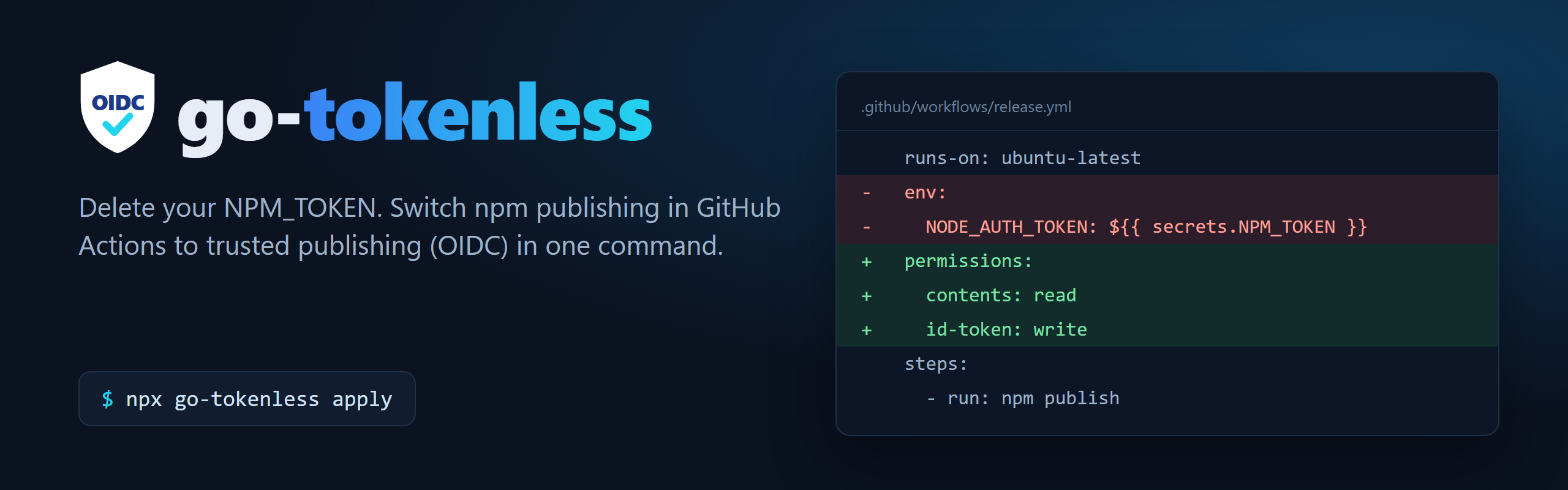
Migrate npm publishing to trusted publishing (OIDC)
From January 2027, a granular npm token that bypasses 2FA can no longer publish on its own (npm docs). The replacement for CI is trusted publishing: GitHub signs a short-lived OIDC token for the workflow run, npm exchanges it for a publish token, and no secret is stored anywhere.
Do it in one command
npx go-tokenless          # preview: lists every change and shows a diff, writes nothing
npx go-tokenless apply    # makes the changes and prints the npm trust commands
go-tokenless (MIT) edits only the lines that need changing. It refuses unsafe cases instead of guessing:
- self-hosted runners
- publish jobs reachable from
pull_request_targetorissue_comment repositorypointing at another repo
The checklist it applies
- OIDC permission: the publishing job has
permissions: id-token: write. - npm version: npm 11.5.1 or newer runs the publish. Node 24 ships it; on Node 22, add
npm install -g npm@^12first. - No token: no
NODE_AUTH_TOKEN/NPM_TOKENreaches the publish step. npm falls back to a configured token. - Registry:
actions/setup-nodehasregistry-url: https://registry.npmjs.org. - Repository field:
package.jsonrepository.urlnames this GitHub repo. - Trusted publisher: one exists on npm for each package, naming the exact workflow file:
npm trust github <pkg> --repo OWNER/REPO --file release.yml --allow-publish --yes - Old secret: deleted after the first tokenless release.
Fix a failing publish
npm error code ENEEDAUTHnpm error 404 Not Found - PUT https://registry.npmjs.org/...npm error code E422…repository.url- Publishing still uses
NPM_TOKENafter the migration npm notice npm tokens that bypass 2FA are being restricted
Use it from an AI coding agent
claude mcp add go-tokenless -- npx -y go-tokenless mcp
It’s also a Claude Code plugin, a Gemini CLI extension and an Agent Skill. See the README.